The One-Sided Bond: Why Your Favorite Creator Feels Like Your Closest Friend
Photo: W.carter, CC BY-SA 4.0, via Wikimedia Commons
You know their coffee order. You know the name of their childhood dog, their complicated relationship with their mom, and exactly how they laugh when something genuinely catches them off guard. You've watched them cry, stumble, rebuild. You've been there — in earbuds on the subway, on your phone at 2 a.m., in the background while you fold laundry — through all of it.
They have no idea you exist.
This is the quiet strangeness of parasocial relationships in 2024, and it's not a niche phenomenon anymore. It's the dominant emotional architecture of an entire generation's social life. And the more we examine it, the more unsettling — and honestly, the more fascinating — it gets.
Your Brain Doesn't Know the Difference
Here's where it starts to get weird: neurologically speaking, your brain processes a familiar online persona almost identically to how it processes a real friend. Research in social neuroscience has shown that repeated exposure to someone's face, voice, and emotional cues activates the same regions associated with genuine social bonding — the medial prefrontal cortex, the temporoparietal junction, areas tied to empathy and social cognition.
Evolution didn't build us for parasocial relationships because they didn't exist. For hundreds of thousands of years, if you recognized someone's face and heard their voice regularly, they were in your tribe. Your brain learned to trust that signal. Now that signal fires every time you open YouTube.
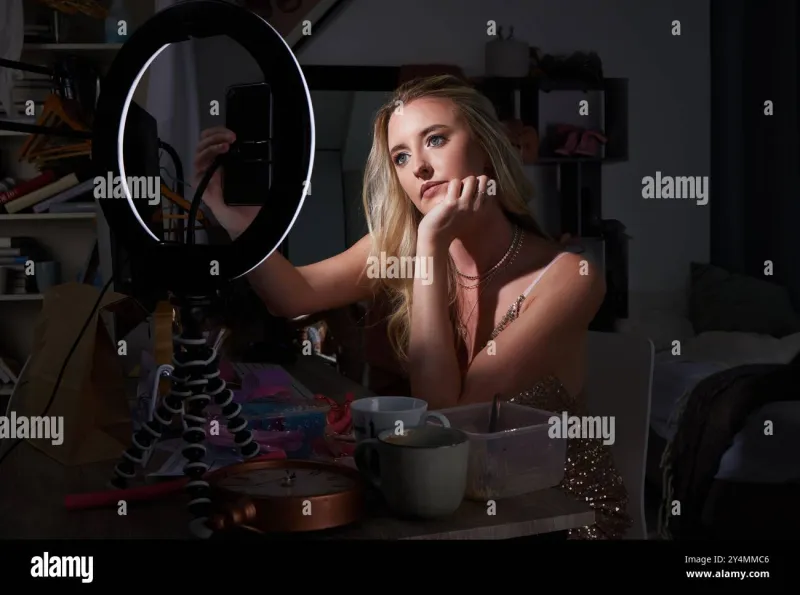
Creators — the smart ones, anyway — understand this intuitively. The casual address to camera, the confessional tone, the deliberate eye contact with the lens. These aren't accidents. They're the grammar of intimacy, deployed at industrial scale.
Curated Vulnerability Is a Superpower
Real friendships are messy and inconvenient. Your actual friends have bad days that bleed into your good ones. They need things from you. They cancel plans. They say the wrong thing at the wrong moment. Friendship requires a kind of sustained emotional labor that, honestly, a lot of us are too depleted to fully show up for.
Online personas offer something different: edited vulnerability. The creator who shares their anxiety disorder has already trimmed the footage where they were just boring and irritable. The podcaster who gets raw about their divorce has shaped that rawness into a narrative with a beginning, middle, and emotionally satisfying arc. What reaches you has been filtered through the part of the process that makes it land.
This isn't cynicism — it's craft. But the effect is that you're receiving something that feels more emotionally coherent than most real human interaction ever is. And your nervous system responds accordingly. It feels good in a way that's hard to replicate over drinks with someone who's distracted by their own stuff.
The Loneliness Accelerant
America was already in a loneliness crisis before the pandemic hit — the surgeon general's office has called it an epidemic. Rates of close friendship have declined steadily since the 1990s. The average American reports having fewer people they can talk to about important matters than their counterparts did thirty years ago.
Into that void walked an entire industry built on simulated intimacy.
It would be too easy to say parasocial relationships caused the loneliness problem. More likely, they're a symptom and a salve at the same time — a way of meeting a genuine human need for connection when the infrastructure for real connection keeps breaking down. Long commutes, expensive cities, overworked schedules, the social awkwardness baked into a decade of phone-first interaction. All of it chips away at the conditions friendship actually needs to grow.
A parasocial bond doesn't need those conditions. It fits in your pocket. It's available at midnight. It never gets tired of you.
When the Comparison Starts to Sting
The problem shows up when people start holding real relationships to a standard that real relationships can never meet.
Therapists and counselors have started noticing it — clients who describe feeling vaguely disappointed by their actual social lives, a low-grade dissatisfaction that's hard to pin down. When you unpack it, sometimes what's underneath is the constant, unconscious comparison to the frictionless emotional experience of their parasocial connections.
Your best friend didn't frame their bad week as a story. They just dumped it on you, raw and unprocessed, and maybe you weren't at your best in how you received it. That interaction doesn't feel as satisfying as the creator who turned their worst month into a 22-minute video that made you feel seen. But one of those is a real relationship, and one of them is a performance of one — however sincere the performer might be.
The risk isn't that parasocial relationships are fake. The risk is that they start to make real ones feel inadequate by comparison.
The Character Problem
There's another layer here that doesn't get talked about enough. Online personas are, by necessity, characters. Even the most authentic creator is presenting a version of themselves — the version that makes sense on camera, that has a consistent personality, that fits within the identity their audience has come to expect.
Real people don't have that kind of consistency. They contradict themselves. They grow in directions that don't fit the narrative. They surprise you in ways that are sometimes wonderful and sometimes just confusing.
When a creator you've followed for years has a public meltdown, or goes through a values shift, or simply starts making different content, the grief some fans feel is real. They're mourning a character. And that character was, in some meaningful sense, a friend.
It says something profound about where we are that we've developed the emotional vocabulary to grieve fictional versions of real people.
What We Do With This
None of this is an argument that parasocial relationships are bad, or that people who have them are broken. They're a completely understandable response to a world that's made genuine connection harder to find and maintain. For people who are isolated, neurodivergent, socially anxious, or just going through a stretch of life where community is hard to come by, these bonds can be genuinely sustaining.
But there's something worth sitting with here. If the most emotionally resonant relationships in your life are one-sided — if the person who feels like they get you has never heard your name — that's worth examining. Not with shame, but with curiosity.
Because the thing that makes a parasocial bond feel so good is actually just a reflection of what you're hungry for. And that hunger? That's real. The question is whether you're feeding it, or just taking the edge off.
Somewhere out there, someone is making content about their most vulnerable moments, and millions of people are watching and thinking: finally, someone who understands. And maybe that's not so different from what we've always wanted from each other. We just haven't figured out how to get there without the edit.