The Overshare Effect: When Creators Get So Real It Gets Weird
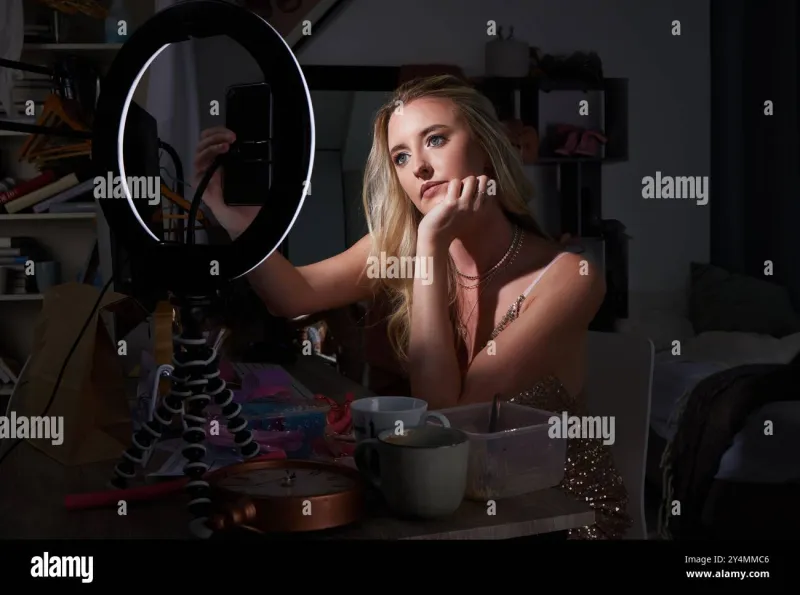
Photo: influencer filming emotional video with ring light close up, via c8.alamy.com
Somewhere between the fourth "raw and unfiltered" morning routine video and the tearful Instagram story about "just needing to be honest with you guys," something shifts. The warmth you used to feel watching a creator you liked cools into something closer to unease. You can't immediately name it. You just know the vibe is off.
Welcome to the parasocial uncanny valley — that unsettling psychological territory where performed closeness stops reading as genuine and starts reading as something else entirely.
Familiarity That Goes Too Far
The uncanny valley is a concept most people know from robotics and animation: the closer something inhuman gets to resembling a real person, the creepier it becomes. A cartoon character is fine. A photorealistic CGI face that's almost human? Nightmare fuel. The same principle, it turns out, applies to digital relationships.
Parasocial bonds — the one-sided emotional connections audiences form with creators, actors, or public figures — have always been part of media consumption. You rooted for your favorite TV character. You felt like you knew a radio host. That's old news. What's different now is the precision with which the influencer economy has learned to manufacture those feelings at scale.
Creators aren't just making content anymore. They're engineering intimacy. And when that engineering becomes visible, the whole thing curdles.
The Tell-Tale Signs of Performed Vulnerability
Audiences are getting sharper at spotting the seams. There's a particular pattern that tends to trigger collective discomfort online: the creator who reveals something deeply personal, but does so with suspiciously good lighting. The one who cries on camera but remembers to mention their sponsor in the same breath. The one whose "unplanned" confession video arrives exactly when their public image needed a reset.
It's not that vulnerability itself is fake. Plenty of creators have shared genuinely difficult things and come out more trusted for it. The difference is in the texture. Real vulnerability tends to be awkward, incomplete, and a little uncomfortable to watch. Performed vulnerability is polished. It hits its beats. It resolves cleanly.
American audiences, in particular, have grown up inside a media culture that has been selling them "realness" as a product for decades — from reality TV confessionals to carefully curated social media aesthetics. We've absorbed the grammar of authenticity so thoroughly that we can feel when someone is speaking it as a second language.
Case Studies in Overcorrection
Consider the creator archetype that became briefly notorious a few years back: the mega-influencer who, after years of aspirational lifestyle content, pivoted hard into "I'm just like you" territory. Suddenly the private jets were gone, replaced by footage of grocery runs and mental health check-ins. The comment sections didn't respond with warmth. They responded with suspicion. Not because the struggles weren't real, but because the rebranding felt too choreographed, too aware of itself.
Or think about the YouTube confessional format that exploded in the early 2020s — hour-long videos where creators walked audiences through their trauma, their breakdowns, their private failures. Some of those videos were genuinely moving. Others left viewers feeling strangely used, like they'd been handed someone's diary not as a gift but as a transaction.
The discomfort isn't moral judgment. It's pattern recognition. Something in the audience's gut says: this is shaped too carefully to be spontaneous.
Why Our Instincts Are Evolving
There's a generational shift happening in how people relate to creators, and it's worth paying attention to. Younger audiences — particularly Gen Z — tend to be more fluent in the language of media performance than any previous generation. They've grown up not just consuming content but making it, studying it, deconstructing it in real time on platforms like TikTok and Twitter.
This fluency means they're quicker to clock inauthenticity, but it also means they're developing a more nuanced relationship with the idea of authenticity itself. Many younger viewers don't necessarily expect their favorite creators to be "real" in some pure, unmediated sense. What they want is consistency, self-awareness, and a kind of honesty about the fact that everything online is, at least partially, a performance.
The creators who are thriving right now in that demographic tend to be the ones who acknowledge the artifice rather than hiding it. They're not pretending the camera isn't there. They're making the camera part of the bit.
The Post-Authenticity Recalibration
What we might be living through is a kind of collective recalibration of what we actually want from parasocial relationships. The authenticity era — that long stretch where the most valuable currency a creator could have was seeming genuine and unfiltered — may be giving way to something more complicated.
Audiences still want connection. That hasn't changed. But they're increasingly skeptical of the mechanisms that simulate it. The oversharing, the emotional reveals, the "I almost didn't post this" disclaimers — these moves have been used so many times that they've lost their original charge.
What replaces them is still being figured out in real time, in comment sections and group chats and Reddit threads where people try to articulate why a creator they used to love now makes them feel vaguely weird. The language is still catching up to the feeling.
But that feeling — that particular low-grade unease when someone tries just a little too hard to make you feel like you know them — is becoming one of the defining textures of online life in the mid-2020s. And the more we can name it, the better equipped we are to navigate the strange, over-intimate world of digital connection that isn't quite going away anytime soon.