When Knowing Everything Feels Like Nothing: The Eerie Edge of Creator Intimacy

Photo: Susanne Nilsson from Trelleborg, Sweden, CC BY-SA 2.0, via Wikimedia Commons
There's a specific flavor of weird that hits you around hour three of a creator's vlog series. You're folding laundry, half-watching, and suddenly the person on your screen says something so personally vulnerable — something about their parents, or a health scare, or a relationship falling apart — and you feel this strange double sensation. Concern, sure. But also something else. Something colder. A recognition that you care about someone who has absolutely no idea you exist.
That feeling has a name now, sort of. Researchers and therapists are increasingly pointing to what some are calling the parasocial uncanny valley — the psychological no-man's-land where a creator relationship gets so detailed, so textured, so emotionally loaded that it starts to feel wrong in ways that are hard to articulate.
The Illusion Gets Too Good
Parasocial relationships aren't new. Teenagers have been writing fan mail to movie stars since the 1920s. What's changed is the density of the connection. Old-school celebrity worship operated at a comfortable distance — you saw someone on a screen, maybe in a magazine, and your imagination filled in the rest. The fantasy had room to breathe.
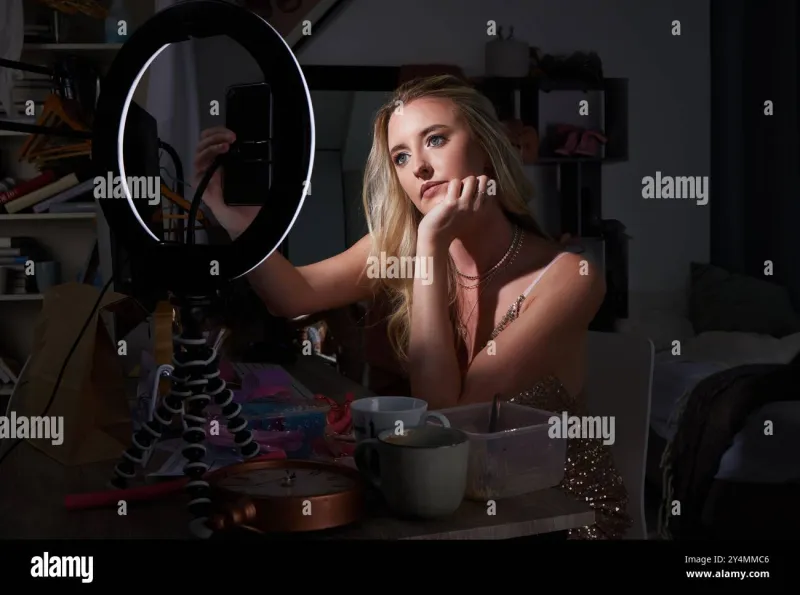
Creators on YouTube, TikTok, Twitch, and Substack have collapsed that distance almost entirely. They're filming in their bedrooms. They're crying on camera after arguments with their partners. They're doing "day in my life" content that documents what they eat for breakfast and how they feel when they can't sleep. The intimacy is architectural. It's baked into the format.
Dr. Pamela Rutledge, a media psychologist who has studied parasocial dynamics for years, has described this compression as a kind of "emotional hyperrealism" — the audience receives so much authentic-feeling detail that the brain begins processing the relationship through the same neural pathways it uses for actual friendships. Which sounds harmless, maybe even nice, until the illusion develops a crack.
The Moment It Tips
Audiences report a remarkably consistent set of triggering moments — specific situations where the parasocial warmth curdles into something unsettling.
One common scenario: the creator does something that a real friend would never do. They forget a major thing they mentioned months ago, contradicting their own stated values without acknowledgment. Or they respond to a fan with a coldness that feels jarring — not cruel, just... indifferent. The curtain twitches. You get a glimpse of the machinery.
Another trigger is what some fans describe as the "stranger in the room" moment. You're watching someone you feel like you know, and they reference something that makes you realize you are, from their perspective, a number in an analytics dashboard. The warmth drains out of the interaction all at once. It's not betrayal exactly. It's more like finding out a place you loved was always a set.
There's also the overfamiliarity inversion — the point where knowing so much about someone starts to feel invasive rather than intimate. Fans describe this as a creeping discomfort with their own knowledge. You know this person's therapy history, their family estrangements, their financial anxieties. And you realize: you didn't ask for most of this. It was served to you in optimized content packages designed to maximize emotional engagement.
Intimacy as a Delivery Mechanism
This is where the tech layer gets uncomfortable. The parasocial relationship isn't just a byproduct of creator culture — it's a feature. Platforms actively reward the content that generates the deepest emotional investment. Vulnerability performs. Confession drives retention. The algorithm has essentially discovered that simulated intimacy is one of the most effective engagement tools ever built.
Which means the "authenticity" audiences are responding to exists inside a system that has strong financial incentives to produce it. Creators aren't necessarily being cynical — many of them are genuinely sharing real pieces of themselves. But those genuine pieces are being selected, shaped, and timed within a content strategy. The realness and the performance are inseparable, and audiences are starting to sense that, even when they can't name it.
Social media therapist Dr. Josh Klapow has noted that this ambiguity can produce a specific kind of low-grade anxiety in heavy consumers of creator content — a background hum of not-quite-trusting their own emotional responses. "You feel connected," he's explained in various interviews, "but you can't verify the connection. And the human brain really doesn't like unverifiable emotional data."
The Dread Is the Point
What makes this phenomenon distinctly modern is that the dread doesn't necessarily make people stop watching. For a significant portion of audiences, the uncanny feeling becomes part of the draw. There's something almost addictive about sitting with the discomfort — returning to a creator's channel not just for comfort but to interrogate the comfort itself.
This tracks with how Ibilit readers tend to engage with content in general: not looking for easy answers, but for the texture of a question. The parasocial uncanny valley isn't a bug in how we consume creator culture. It's a window into something genuinely strange about what connection means when it's mediated, packaged, and infinitely scalable.
Fans in online discussion spaces describe building elaborate mental models of creators — tracking inconsistencies, debating authenticity, forming communities around the shared project of figuring someone out. It's parasocial relationship as collaborative detective work. The intimacy becomes a puzzle rather than a comfort.
What Comes After the Chill
Some audiences disengage entirely when the uncanny feeling hits. Creators report sudden drops in longtime viewers with no clear content explanation — people who simply reached their threshold and quietly walked away. Others recalibrate, consciously shifting how they relate to the creator, treating it more like following a character than knowing a person.
A smaller but vocal group goes the other direction: doubling down, seeking more content, as if more information will eventually resolve the discomfort. It rarely does. The uncanny valley, by definition, is a space you can't think your way out of. More data doesn't fix it.
What might actually help, according to media literacy advocates, is wider cultural acknowledgment that these relationships are a new kind of thing — not friendships, not fandom in the old sense, but something without a clean category yet. Naming the feeling, understanding its mechanics, recognizing that the discomfort is a rational response to a genuinely strange situation — all of that seems to reduce its grip.
Until then, millions of Americans will keep folding laundry, watching someone they almost know, feeling something they can't quite describe. The screen glows. The creator laughs. And somewhere in the space between them, something flickers that isn't quite connection and isn't quite not.