Fan Turned Mirror: How Audiences Learned to Perform Right Back
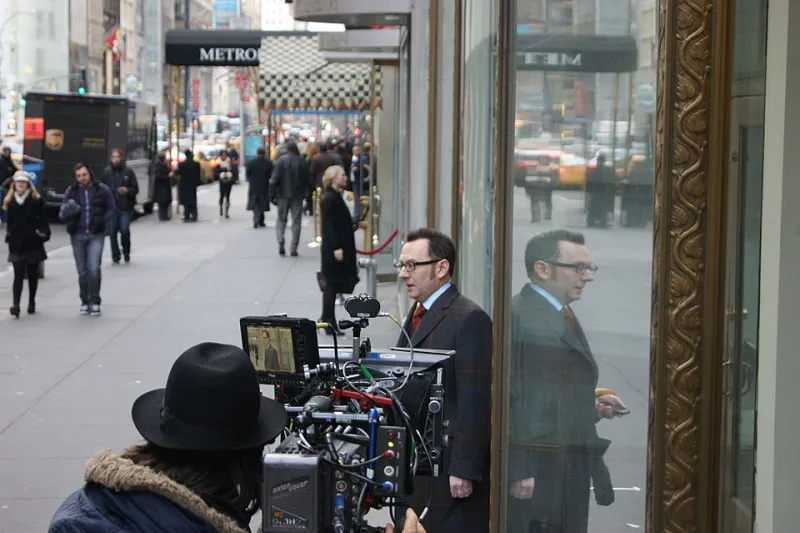
Photo: Sebastian Sommer, CC BY-SA 3.0, via Wikimedia Commons
There used to be a pretty clean line between the person on the screen and the person watching it. One performed. The other consumed. That arrangement held for decades — through the golden age of Hollywood, through the rise of MTV, through the early chaotic years of YouTube. But somewhere in the mid-2010s, the line started to blur. And now, in 2025, it's basically gone.
Fans aren't passive anymore. They're not just reacting — they're producing. They're engineering moments, crafting personas, and inserting themselves into celebrity narratives with a level of intentionality that would have seemed unhinged twenty years ago. What's wild is that it doesn't feel unhinged at all. It feels completely normal. That normalization might be the most unsettling part of the whole thing.
The Staged Candid Is an Art Form Now
Let's talk about the "chance encounter" video. You've seen hundreds of them. A fan "accidentally" runs into their favorite artist at a coffee shop, a hotel lobby, a farmers market in Silver Lake. The camera is already rolling. The lighting is surprisingly decent. The fan's reaction is perfectly calibrated — not too hysterical, not too cool, just the right amount of overwhelmed. It goes viral. The celebrity reposts it.
Everybody wins. Except the version of authenticity we used to believe in.
These aren't spontaneous moments. They're collaborative productions where both parties understand the assignment even if neither one says it out loud. The fan gets clout, followers, a story. The celebrity gets humanized, gets shown as accessible and warm, gets content without having to generate it themselves. It's a transaction dressed up as a feeling.
And the audience watching at home? They know, on some level. But the performance is good enough that they choose to believe it anyway. That choice — that willful suspension of disbelief — is where things get genuinely interesting.
When Fan Fiction Becomes the Official Record
Social media didn't just give fans a megaphone. It gave them editorial power. When a celebrity does something ambiguous — posts a cryptic caption, shows up somewhere unexpected, goes quiet for two weeks — fans don't wait for an explanation. They build one. They write the narrative, circulate it, refine it through thousands of comments and stitches and quote-tweets until it calcifies into something that feels like fact.
Celebrities have started responding to those narratives. Not always directly, but you can see it. A star who got labeled "unbothered" starts leaning into unbothered aesthetics. Someone who got cast as the villain in a fan theory starts making softer, more vulnerable content. The audience writes the character, and the real person starts playing it.
This is new. This is genuinely unprecedented in the history of celebrity culture. Stars have always managed their image, but they used to control the input. Now they're reacting to outputs they didn't create, adjusting themselves to fit stories they didn't write, in real time, in public.
The Hollow Center of Mutual Performance
Here's the thing nobody really wants to say: when everyone is performing for everyone else, the actual connection disappears.
The parasocial relationship — that one-sided emotional bond where a fan feels close to someone who doesn't know they exist — used to have a kind of tragic honesty to it. The fan knew, deep down, that the intimacy wasn't real. The celebrity was a projection surface. That asymmetry was built into the structure.
But now the structure has flipped and folded back on itself. Fans perform connection. Celebrities perform reciprocation. The whole thing becomes a hall of mirrors where nobody can find the original image anymore. Both sides are getting something out of it — engagement, validation, reach, the warm feeling of being seen — but the thing they're exchanging isn't actually intimacy. It's the performance of intimacy, endlessly reproduced.
And that performance leaves a residue. Fans report feeling empty after their "moment" goes viral. Celebrities describe exhaustion from having to constantly respond to narratives they didn't generate. The loop feeds itself but doesn't nourish anyone inside it.
The Power Shift Nobody Fully Controls
What makes this era so genuinely strange is that the power dynamic has shifted without anyone actually gaining stable power. Fans have more influence than ever, but that influence is diffuse, unpredictable, and can turn toxic overnight. A celebrity can be built up by fan narrative one week and dismantled by it the next — not because they did anything different, but because the story changed.
Celebrities have adapted by becoming increasingly reactive, which paradoxically makes them more vulnerable to the next wave of fan-driven narrative. They're chasing a moving target that their own responsiveness keeps moving further.
Meanwhile, the platforms — Instagram, TikTok, X — sit in the middle of all of this, algorithmically amplifying whatever generates the most engagement, whether it's genuine or manufactured. The algorithm doesn't distinguish between a real moment and a staged one. It just measures heat. And heat is something both fans and celebrities have learned to generate on demand.
What Comes After the Performance
There's a generation of people right now — mostly in their teens and twenties — who have grown up inside this dynamic. For them, the performance is the relationship. The staged reaction, the engineered encounter, the fan-written narrative — these aren't distortions of authentic connection. They're just how connection works.
That's not necessarily a cynical observation. It might just be an honest one. Every generation inherits a new set of social technologies and builds its emotional life around them. This generation got social media, and they built something genuinely new with it — a form of collective storytelling where the line between audience and subject is permanently, irreversibly smeared.
What gets lost in that smear is harder to name than it is to feel. It's something like the possibility of being genuinely surprised by another person. When everyone is performing, when every reaction is calibrated, when every encounter is at least half-engineered, the space for actual surprise — for the unscripted, unoptimized human moment — keeps shrinking.
Maybe that's fine. Maybe we're building something new in the space where that used to live.
Or maybe we're all just getting really good at performing like it's fine.