Glitch in the Matrix: Why Young Americans Are Ditching Streams for Tapes and Turntables
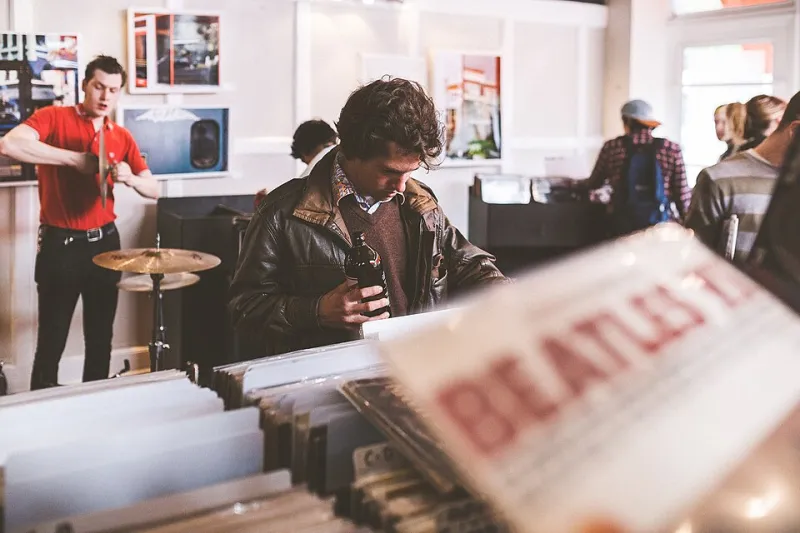
Photo: Samuel Dixon samueldixon, CC0, via Wikimedia Commons
Walk into almost any Goodwill in a mid-sized American city right now and you'll notice something weird. The VHS bin — the one that used to sit there untouched, a graveyard of Kindergarten Cop copies and workout tapes — is getting picked through. Carefully. By people born after the format was already dying.
This isn't an accident, and it's definitely not irony. Something real is shifting in how younger Americans relate to the media they consume, and it cuts a lot deeper than vintage aesthetics.
Ownership Isn't Dead — It Just Went Underground
Here's the thing about streaming: you don't own anything. You rent access to a catalog that can change without warning, get geo-restricted, or vanish entirely when licensing deals expire. Ask anyone who had a carefully curated Netflix watchlist in 2019 how that's going now.
For a generation that grew up being told digital was the future, a growing slice of Gen Z has started doing the math — and they don't love the answer. Physical media doesn't require a subscription. It doesn't need a password. It can't be remotely revoked. A VHS tape of The Thing bought for $2 at an estate sale will play on any working VCR until the magnetic oxide literally wears off the plastic. That's a kind of permanence that a streaming license simply cannot offer.
Collectors on Reddit communities like r/VHS and r/vinyl talk about this constantly. Not always in political terms, but the sentiment is consistent: I want to actually own the thing. In an economy where young people are increasingly priced out of home ownership, car ownership, and even stable employment, the ability to hold something in your hands and say "this is mine" carries unusual emotional weight.
The Privacy Angle Nobody's Really Talking About
Beyond ownership, there's a quieter motivation that doesn't make it into most trend pieces about the analog revival: data.
Every stream you watch is logged. Spotify knows not just what you listen to, but when you pause, when you skip, and how many times you replay a specific 30-second section of a song. Netflix tracks viewing patterns down to the minute. These platforms have built extraordinarily detailed behavioral profiles on their users — profiles that inform everything from recommendation algorithms to advertising partnerships.
A vinyl record spins with zero data collection. A VHS tape plays back with no telemetry. There's no engagement metric being harvested, no watch-time percentage being reported to an advertiser. For a generation that came of age reading headlines about data breaches and surveillance capitalism, that blankness feels almost radical.
"I don't want an algorithm deciding what I like," one 22-year-old collector from Portland told a community forum earlier this year. "When I dig through a crate at a record store, I'm deciding. Nobody's optimizing that experience for me."
That distinction — between curated discovery and algorithmic delivery — sits at the heart of why this revival has legs beyond mere nostalgia.
The Tactile Economy
There's also something that digital maximalists consistently underestimate: the physical experience of analog media is genuinely different, and that difference matters to people.
Vinyl has album art you can hold. The ritual of cleaning a record, lowering the needle, and hearing that warm crackle before the music starts is a multi-sensory experience that a Spotify playlist simply cannot replicate. VHS tapes have that magnetic shimmer, those tracking artifacts, that slightly degraded color palette that makes everything feel like it's being remembered rather than played back. Even the weight of a physical object — the satisfying thunk of a cassette going into a deck — activates something that a tap on a touchscreen doesn't.
This isn't just sentimentality. Cognitive research has consistently found that physical interactions with objects create stronger memory encoding than purely digital ones. The analog experience leaves a mark.
Record stores that were closing a decade ago are reopening. Urban Outfitters started selling turntables, which initially seemed like a cash-grab gimmick but ended up introducing an entire generation to the format. Cassette sales have quietly climbed for six consecutive years according to music industry tracking data. The numbers are still small compared to streaming, but the trajectory is unmistakable.
Underground Communities, Real Culture
What makes this more than a consumer trend is the community infrastructure building up around it. VHS collector meetups happen in cities from Chicago to Austin. Zine culture — physical, printed, deliberately un-SEO'd — is thriving in college towns. There are underground tape-trading networks operating through Discord servers and physical mail, a direct echo of the mix-tape culture of the '80s and '90s.
These communities have a distinctly anti-algorithmic flavor. There's no feed, no follower count, no engagement metric to chase. Value is established through actual human taste and curation — someone with a great collection earns respect because they've developed genuine knowledge, not because they posted at the right time on the right platform.
It's the kind of cultural ecosystem that the mainstream internet has largely optimized out of existence. And yet here it is, regenerating in the margins.
Beyond the Expected
The easy read on the analog revival is nostalgia — young people romanticizing an era they never lived through. But that reading misses the structural logic underneath. This isn't about the past. It's about building a relationship with media that feels human-scaled, personally owned, and free from the invisible hand of behavioral data systems.
The industry abandoned these formats because they couldn't be monetized at scale. That's precisely why they're interesting again.
In a media landscape increasingly defined by what algorithms decide you should see next, choosing to drop a needle on a record or thread a tape into a VCR is a small but genuine act of self-determination. And for a generation that has grown up inside systems designed to capture their attention and sell it back to them, that might be exactly the kind of glitch worth embracing.