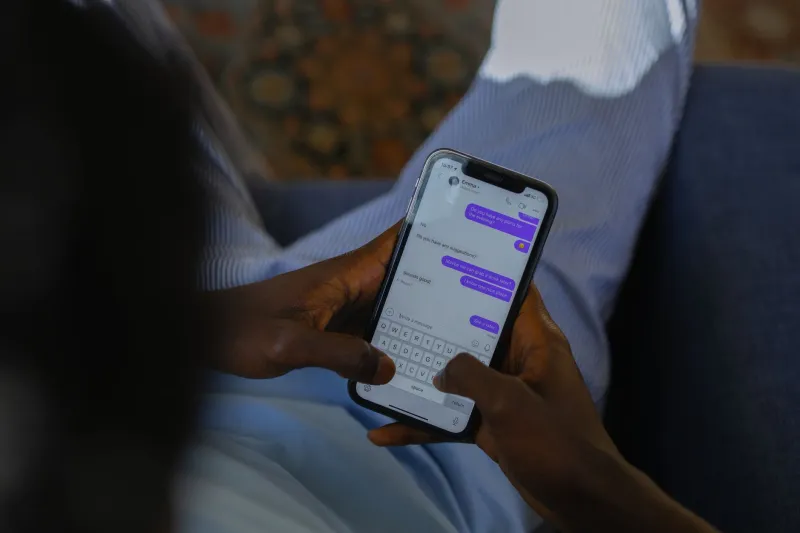
You Knew Everything About Them Online. Then You Met in Person and Felt Nothing.

There's a specific kind of silence that happens when two chronically online people finally share a physical room. It's not the comfortable kind. It's the silence of two people who have exchanged thousands of words, dozens of voice memos, maybe even cried together over text — and who are now staring at each other across a coffee shop table like strangers at a job interview they both forgot to prepare for.
If you've experienced this, you already know the particular dread of it. If you haven't yet, you probably will.
The Friendship That Lives in the Screen
Digital intimacy operates on its own physics. Online, you get to curate your presence. You respond when you're ready. You have time to think before you speak. You can be funnier, more articulate, more emotionally available than you might naturally be in the chaos of real-time human interaction. And your friend is doing the exact same thing back to you.
What you're building isn't fake, exactly. The emotions are real. The connection is real. But the version of each other you're connecting with has been unconsciously refined for the medium. You're both performing a slightly elevated, slightly edited version of yourselves — not out of deception, but because the platform demands it.
This is fine. Until it isn't.
The moment you step into a shared physical space, all the scaffolding disappears. There's no edit button on a facial expression. There's no time to craft the perfect response when someone says something unexpected. The algorithm that made your friendship feel so effortless — the one that let you communicate in memes and midnight voice notes — doesn't run in real life. And suddenly, two people who thought they knew each other intimately are meeting for the first time.
When Closeness Becomes Its Own Kind of Distance
Here's the part that gets genuinely strange: the more intensely intimate the online friendship, the more disorienting the IRL meeting tends to be. This isn't intuitive. You'd expect that deeper connection would translate smoothly across formats. But what actually happens is the opposite.
The depth of the digital relationship creates a kind of pressure. You've built up so much shared history, so many inside references, such an elaborate emotional architecture together — and none of it seems to load correctly in person. Your friend laughs differently than you imagined. They're quieter, or louder, or they fidget in ways you weren't prepared for. The cadence of their actual voice doesn't match the one you'd been running in your head.
Psychologists sometimes talk about the uncanny valley in the context of robotics — that eerie discomfort that happens when something is almost human but not quite right. What's happening here is a social version of that same phenomenon. You're encountering someone who is almost exactly the person you know, but slightly, persistently off. And that slight wrongness is somehow harder to process than meeting a total stranger would be.
The Architecture of the Online-Only Friendship
Some friendships, if we're honest, are architected specifically for digital existence. They were born in comment sections or Discord servers or niche subreddits. They thrive in the asynchronous back-and-forth of DMs. They're built around shared references and parasocial bonds with the same creators, the same aesthetics, the same internet microcultures.
There's nothing inherently wrong with that. But it does mean those friendships carry a kind of implicit contract: we exist here, in this space, on these terms. Dragging them into the physical world isn't just a change of venue — it's a renegotiation of the entire relationship, one that neither party necessarily signed up for.
And a lot of people, when they examine this honestly, realize they don't actually want to renegotiate. The online version of the friendship is doing exactly what it's supposed to do. It provides intimacy without the full weight of physical presence. It offers connection without the logistical friction of actual proximity. It lets you be close to someone in a way that fits neatly into your life without disrupting it.
Is that a lesser form of connection? Maybe. Maybe not. The question is worth sitting with.
The Chronically Online Identity Problem
There's a deeper issue underneath all of this, and it's one that's becoming increasingly common among younger Americans who grew up with their social lives substantially routed through screens. When your identity is heavily constructed through online participation — through the communities you're part of, the content you consume, the persona you've cultivated across platforms — you may find that your IRL self feels underdeveloped by comparison.
Not worse, necessarily. Just less practiced. Less fluent.
A lot of people who consider themselves deeply introverted or socially anxious have found that online spaces gave them a genuine workaround — a place where they could connect meaningfully without the parts of socializing that felt most difficult. That's genuinely valuable. But it can also mean that the offline self gets less rehearsal time. And when the offline self has to show up and perform without the safety net of a screen, the results can be genuinely disorienting for everyone involved.
You're not pretending to be someone else online. But you might be a more finished version of yourself there. And meeting someone who only knows that version of you — and then having to introduce them to the rougher, less edited one — can feel strangely exposing in a way that's hard to name.
Does the Meeting Have to Mean Anything?
Here's a reframe that might actually be useful: maybe the discomfort of the IRL meeting doesn't mean the friendship was false. Maybe it just means the friendship was specific.
Not every connection is meant to be portable. Some of the most meaningful relationships in your life might be ones that exist beautifully within a particular context and awkwardly outside of it. That's not a failure. That's just the shape of the thing.
The weird part is that we've been culturally trained to treat the physical meeting as the real test — the moment that confirms whether an online friendship was genuine. But that framing might be outdated. If two people have genuinely supported each other through difficult moments, laughed together consistently, shaped each other's thinking in real ways — does the fact that they freeze up at a coffee shop table actually undo any of that?
The answer probably depends on what you were looking for in the first place.
Living in the Ibilit
We're in a moment where the lines between digital and physical identity are genuinely blurry in ways they've never been before. The friendships we're forming online aren't simulations of real friendships — they are real friendships, just ones that operate according to a different set of rules.
The disorienting IRL meeting isn't necessarily evidence that something went wrong. It might just be evidence that you're navigating a form of human connection that doesn't have a clean playbook yet. The map is still being drawn. And sometimes the most honest thing you can do is acknowledge that the territory is stranger than you expected — and keep showing up anyway, in whatever format the friendship actually lives.